Wednesday, November 19, 2008

Lakme Compact Powder Price

forecasts of the IEA for the worsening climate crisis continues

On contreinfo: Energy and climate: current trends are unsustainable, warns the IEA


"Trends in current supply and consumption are clearly unsustainable - environmentally, economically and socially. They can and should be changed, "warns Nobuo Tanaka, executive director of the International Energy Agency. Cautioning against voltage expected due to the accelerated decline of deposits and the increase in demand - it will bring into production the equivalent of six Saudi Arabia to 2030 - he believes that "the era of cheap oil is complete. "On the part of the fight against global warming, challenges will lie ahead not less. Although OECD countries reduced their emissions to nothing, the limit of 450 ppm CO2e would still be exceeded. Excerpts from last Agency report, here are the facts, figures and tables describing the magnitude of the task.

International Energy Agency, November 12, 2008

"We can not let the financial crisis and economic delay political action urgently needed to ensure security of energy supply and reduce the increase emissions of greenhouse gas emissions. We must make a global revolution in the field of energy, consisting of improved energy efficiency and increasing implementation of low-carbon energy, "said Nobuo Tanaka, executive director of the International Atomic Energy Agency (IEA) in London to mark the presentation of the "World Energy Outlook (WEO) 2008" - the new edition of the publication of the agency that provides a prospective table on energy issues.

Projections

In the baseline scenario of the WEO-2008, which assumes the continuation of current government policies:

- the global primary energy demand grows by 1.6% per year on average between 2006 and 2030 - an increase of 45%. Figure lower than expected last year, mainly due to the impact of the economic downturn, the prospect of higher prices and new policy initiatives.

(JPG)

- Oil demand increases by 85 million barrels per day currently to 106 mb / d in 2030 - Or 10 mb / d less than expected last year.

- Coal demand increases more than any other source of energy in absolute terms, accounting for more than a third of the increase in energy consumption.

(JPG)

- Modern renewables grow faster than the gas to become the second largest source of electricity soon after 2010.

(JPG)

- China and India account for over half of the increase of energy demand by 2030 while the Middle East is a new and consuming region.

(JPG)


to read the whole article: Energies and climate : current trends are unsustainable, warns the IEA

Template For Announcing The Joining Of Doctor

the 2008 report of the WTO's Online

growth of world trade has fallen to 6 percent in 2007, as confirmed by a report from the WTO: International Trade Statistics 2008

explanations are threefold:

  1. A contraction demand in developed countries,
  2. currency realignments and changes in commodity prices such as oil and gas, have introduced uncertainties in global markets in 2007
Consequently, growth World merchandise trade has fallen to 6 per cent in real terms, against 8.5 percent in 2006, according to statistics released by the WTO on November 5.

These figures are contained in the official full statistics for 2007, entitled "International Trade Statistics 2008". Growth 6 per cent of trade is slightly higher preliminary evaluation of 5.5 percent announced in April but still represents a very significant drop from the 2006 figure.

The report said the slowdown "is due to a slowdown in import demand, mostly U.S. but also in Europe and Japan".

"Trade remained strong in most developing countries . In regions like Africa, Middle East, Commonwealth of Independent States (CIS) countries in developing Asia and Central and South America, economies have experienced sustained growth in 2007. "

" Although rising commodity prices have contributed to improve the financial situation of some countries, higher energy and food prices also increased inflationary pressures in the world. "

Rising prices of commodities has increased by 19 percent the total value of exports agricultural products, an increase that was higher than that in the case of trade in manufactured goods, fuels and mining products.

For the first time in five years, trade in commercial services has increased in value more rapidly than trade in goods, 18 per cent against 15 per cent. This is mainly due to increased supply at international level, a large number of financial services, IT services and business services, professional services and technical services variety, as well as the rising price of transportation.


This publication and its data can be obtained free on the website of the WTO in the following forms:


complement a Video debate: The global food crisis: What is the role of trade? top


> Download

Tuesday, November 18, 2008

How Long Heal After Brazilian Wax

Sunday work in political debate

Sunday working in debate:

Nicolas Sarkozy explained Rethel (Ardennes), Oct. 28. "Why continue to prevent anyone who wants to work on Sundays? , asked the president, as he likes rhetorical questioning in this case. C 'is a day of growth Increasingly, it's purchasing power and more. You still have to think of the families who have the right, the days they do not work, go to shop in stores that are open and not closed automatically . " And the head of state and supporter of "liberate all of this" , invited parliamentarians to "seize without taboos" of the proposal Bill filed to this effect in early August by the MP (UMP) of the Bouches-du-Rhone Richard Mall.


debate is launched:

In an interview published in the Journal du Dimanche , Luc Chatel said that "wherever stores open on the seventh day, the activity was promoted . According to him, "the e commerce Sunday's jobs and growth". " "Our goal is to relax the law, but by preserving the local equilibrium," he added, estimating that it will be for "industries, not the law" to define the conditions of any refusal employees.

According to a poll published by Ifop Publicis Consultants and directed the JDD 22 and September 23, 67% of French agree to work on Sundays, which is paid more than a week, if their employer offered. They were 59% to give the same response in December 2007, in a previous survey.

It "shows that minds are changing," said Xavier Bertrand Sunday on France 2. must be given the opportunity to work on Sundays, but on a voluntary basis , "said Minister of Labour, insisting on" safeguards "to make. He supported that employees be paid "twice" that day.

Yet everyone disagrees in particular trade unions dispute the effectiveness of these measures:

The visit that the two ministers made in Thiais Village illustrated the controversy on the subject. Twenty prefectural exemptions were granted in August, signs of this shopping center, whose stores Decathlon, Boulanger or Fnac but unions CFTC and FOR have challenged the tribunal. The appeal is suspensive, this retail center, apart from Ikea, are subject to penalties if they fail to comply with the law.

"We regret that two ministers are legitimate signs outlawed, said two officers of the CFTC, Eric Scherrer and Joseph Thouvenel, who arrested the ministers. Both unionists have said that Sunday working would the "d ESTRUCTION stable than 100,000 jobs in small independent businesses to downtown."

at: work Sunday


showed up weaknesses in the JDD poll and presented another survey (by the way as questionable ) controlled by FOR to BVA:

As economists they are at least skeptical about the value of a such as:

For the director of the Research Centre for the Study and Observation of Living Conditions (Credoc), Robert Rochefort, "no economist can say we need to open across the Sunday ".

In the pages of the world views an excellent article ASKENAZY p: The price of Sunday, by Philippe Askenazy

"The current debate seems a repeat of the beginning of last century on the Sunday holiday for everyone. arguments on the occasion of the 1906 Act can be found in the mouth of the same players. The employers supported the Sunday work. The Catholic Church wishes to maintain this day holiday, devoted to church and family. The unions will add the needed rest of the employees. It only lacks the military: the wear of youth by working 7 days on 7 raised concerns about the ability of France to raise an army of soldiers able to wash the humiliation of 1870. This last argument had finally bring progress is undeniable that the Sabbath. "

comparison with USApays which has long been a fan of horraires shifted and whose amplitude is maximal:

" Let's cross however the Atlantic. United States, the Most supermarkets (food) are open 24 hours on 24, 7 / 7. Yet signs are quietly lobbying for regulation of opening hours. In fact, they find themselves in an expensive balance become vicious. The fierce competition prevents, or risk losing valuable customers, reduce the amplitude of opening. And this high amplitude involves two major costs.

The first is energy. Supermarkets, particularly food, are among the most energy-intensive activities : powerful entirely artificial lighting, heating or air conditioning immense volumes, large rays refrigeration open and often manipulated. In this time of the Grenelle Environment Forum, he is so funny that we do not question the environmental impact of Sunday opening in France "

The second major cost is labor. Overseas Atlantic, despite the absence (or weakness) of bonus for night work and Sunday, the high amplitude zone participates in consumer expenditure per hour worked in small shops: in the food, they are twice low in the U.S. than in France.

On the site of a capital P Burban representatives of the artisans are two other limitations:

Capital.fr: Easing Sunday working would be following two principles: voluntary and pay doubled. Is not this a good thing? Pierre Burban
:
(Laughs) .... An employee who refuses once, then again Sunday work will position itself in an awkward position in front of his employer. And double the pay is not an element to justify a generalization of work on Sunday.

Capital.fr: Working on Sunday is expected to create jobs by government. This will be there at the expense of small businesses? Pierre Burban
:
This idea of creating jobs is questionable. A generalization Sunday working will benefit the big retail groups. But it will destroy jobs in the local shops. Indeed, the same turnover, it employs three times more staff than supermarkets


Finally P ASKENAZY note:

The theoretical impact of the opening Sunday is thus ambiguous. Hence the importance of empirical work on the North American cases. U.S. states or Canadian provinces do not simultaneously deregulated opening shops on Sundays. The statistical analysis of this diversity allows identify the specific effects of this deregulation. Estimates are converging. United States and Canada, the net effect on employment is modest but real: the order of 1 to 2% of additional posts. In contrast, the number of hours available per employee remains unchanged: those who work on Sunday losing hours on weekdays, with a total impact on their salary is very low. This probably leads the UMP to advocate a double payment of basic pay on Sundays. But that may exacerbate the costs borne by businesses. Yet already, without such a doubling, the North American studies are unanimous : Sunday opening results in a price increase of about 4%. In France, if the salary is in addition to doubling the glaring weakness of competition between retailers in many parts of the territory a more massive impact on prices is a concern. In fact, there is no miracle that the additional service is purchased Sunday at a cost and this cost is charged or overcharged, customers. Even for those who do not do their shopping on Sunday!

bet that in a crisis purchasing power, prices will quickly argument put forward by employers in the sector ... to demand back on the commitment of doubling earnings, once liberalization achieved. So as not to truncate the debate. And, in particular, ask the French a full question: Do you want a Sunday opening of shops left to suffer higher prices

Monday, November 17, 2008

Fluid In Douglas Pouch

How to end the crisis?

LATEST FORECASTS FROM OECD ARE NOT PARTICULARLY OPTIMISTIC:

"The OECD appears to be in recession and unemployment is rising in many countries that comprise it. The OECD projections suggest a prolonged slowdown in activity, with a likely decline GDP ⅓ per cent in 2009 "


OECD continues:" but the uncertainties are significant, particularly as regards the depth and duration of the financial crisis, the main cause of this decline. In this respect, the forecasts assume a rapid absorption of extreme financial stress observed since mid-September, however, which would leave room for a long period of financial turmoil until the end of 2009, with a normalization then gradually . "Nevertheless

OECD recognizes that" forecasts are surrounded by considerable uncertainty. For 2009, the main risk is that of a more pronounced deterioration in economic conditions. In particular, the financial situation could take longer than expected to normalize, new financial institutions could find themselves on the brink of bankruptcy and emerging market economies could be hit hardest by the slowdown of world trade and a reassessment risk of foreign investors. "

But we can be optimistic:" However, the situation could grow significantly more favorable than expected. "

forecasters OECD after several years of excessive optimism does not recognize that they finally felt like Keynes expectations are never certain, and the margin of error is large

We can see that Keynesian ideas are experiencing a comeback : OECD calls itself "The cleanup of banks' balance sheets could be faster as a result of important and comprehensive measures taken by the authorities . Similarly, one can not exclude the adoption of stimulus larger than assumed in the forecast .

OECD goes even further: In this context of strong economic downturn, stimulus needed macroeconomic . Under normal circumstances, monetary policy, not fiscal policy, would be the instrument of choice, and we did take into account a further monetary easing. However, given the extreme financial pressures currently observed, the monetary transmission mechanism is probably less effective. Moreover, the United States and Japan, the flexibility to further reduce interest rates is limited. "In terms

Keynesian more could we not talk about the trap liquidity?


Finally we return to the old model, yet reviled since the 80s (Friedman, Thatcher and Reagan): "In this unusual situation , (it's true the economy is it not always at full employment ?) fiscal policy also has its place. We'll have to let automatic stabilizers play fully and in countries that have leeway on the budget plan, a discretionary easing of fiscal policy remains an important option in the short term. "

Beware the OECD does not yet give up his traditional speech:" However, it is essential that such a discretionary action to intervene in a timely and is temporary, and is designed for the sake of maximum efficiency . Tax cuts for households facing credit problems could, for example, be effective. Simultaneously, with high public debt in many OECD countries, it will also establish a credible framework for fiscal sustainability in the long term.

yet the situation is worrying réeellement the idea of regulation at international level; "We can not exclude that further measures may be necessary to stabilize financial markets. In this case, international cooperation is desirable to avoid any action that could distort competition or report problems on other countries . "

but there also are not mistaken this is temporary: " It is also important that these measures are designed and implemented so that it can be safely removed when the situation will normalize financial markets ."

to read the full: "Forecasts for the U.S., Japan and the euro area "

in addition to the website of Natixis: 14/11/2008 What the Research Service released this week.
What happened this week?: American risk vs. risk emerging recession in the euro zone, collapse of the pound sterling ...
Energy and Raw Materials: Towards a low growth in oil demand.
What about market trends? France: who can be surprised by the tightening of credit? ", 762, null) 'onmouseout =" Tooltip.hide ();"> Global recession, tighter credit conditions in France decline in GDP in the eurozone, British Pound ...


B Obama seems more pragmatic and ambitious in his first interview:


In the gallery: Barack Obama : all are good ways to counter the recession

"the government must take" all necessary steps to restart the economy and it will take spend money to stimulate the economy .

A statement which is close to the famous Roosevelt's New Deal and Keynesian economics, long hated by economists in vogue in Washington. But Barack Obama has defused criticism by asserting that the ultraconservative the financial crisis had prompted a consensus among economists on both left and right.

"We should not worry about the deficit this year or even next year" said the president elected at the interview.

* He also called "priority issue a "strengthening of financial sector regulation, including the lack of rule is often referred to as a catalyst for the crisis. However, he stated that" the answer (to the crisis, ie) is not a heavy regulation that would crush the spirit of enterprise and risk appetite.

a pragmatic president telling you I


Sunday, November 9, 2008

Supplemental Questionaire Uc

inequalities based on age

site echoes: A Report of the Council levies Mandatory stresses that the tax system operates transfers to the benefit of older assets to the detriment of


The more than 65 years are at the party. After Wednesday, INSEE said they are happier than others, a report by the compulsory contributions came to reveal yesterday that the French tax system is more favorable than other generations. As it stands, the system of compulsory levies "operates an instant transfer for the benefit of households and individuals over 65 years and under 30 years at the expense of active classes" , Said the report presented yesterday by Philippe Seguin, Chairman and first President of the Court of Auditors.

CSG lower

The over 65 "have both a higher standard of living for individuals younger and a lower level of taxation" . The latter results from a "CSG rate much lower on pensions" and a "more favorable to tax unearned income" as those activity, even in the insulating The large size occupied by social contributions in earnings.

By their way of life, beyond the sixties and more widely levies on consumption. With age, firstly, the overall consumption decreases, and secondly, the proportion of low-taxed products (reduced VAT) increases in purchases. For example, they consume more drugs (2.1% VAT), go to museums more often and read more (VAT 5.5%) than their younger counterparts.

same time, the social debt (85 billion euros) product "instant transfers for the benefit of over 65 years" . The breakdown between generations of CRDS, whose function amortize this debt "led to make the only net beneficiaries of the system" with benefits received in excess of their own contribution.

"Free Lunch"

Added to this table the pension system, which "benefited the early generations" who received higher benefits in having contributed less. In short, they have received "free lunch" says Philippe Seguin.

The report notes that "intra-family transfers (gifts, inheritances) encouraged recent reforms have no way sufficient to rectify the situation, insofar as they represent only 1% of total wealth. Similarly, "other tax reforms have had a relatively neutral impact on the intergenerational inequities" says Emmanuel Macron, Rapporteur of the study.

In these circumstances, the Council suggests the tax burden on the executive to better take into account the issue of transfers between generations, so far rarely used as a reading grid, in his choice of fiscal and social policy.

Cliquez ici
The Council stresses that the tax burden over 65 years are generally subject to lower tax level, while they enjoy a standard of living higher than that of younger

On the site of the observatory inequalities:

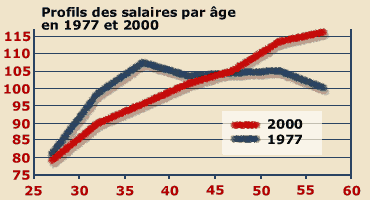
In 1975, employees aged 50 on average earned 15% more than employees of 30 years, age adults living on one foot while equality. Today, the gap is 40%. In 1977, employees from 30 to 34 years earned less than 1.5% the average employee ... 10% less in 2000. Unemployment

helping the fruits of economic growth slowed since 1975, have been reserved for over 45 years. Generational reading to understand that young people valued yesterday became the senior promoted today by seniority. Young people today suffer far more than other age groups the pressure of lack of employment.

Note: 100 = average wage of the year.

Source: Surveys 2000 Employment and Training, qualification and professional 1977, INSEE; archives LASMAS-BMI


To report

complement an excellent slideshow of Louis Chauvel for his course from Sciences Po Paris: [PPT]

PowerPoint Presentation

Saturday, November 8, 2008

Toilet Cistern Replacement

THE PORTRAIT OF THE SOCIAL FRANC E

ON THE SITE OF THE INSEE DERNIERPORTRAIT OFFICE OF FRANCE 2008 Edition
  • Summary

    As every year, Insee offers "France Portrait social 'stock of economic developments Social and observed over the past year. The 2008 edition focuses particul ...

  • Overview

    - The decline in unemployment continued in 2007 - the purchasing power of households accelerates in 2007 - Inflation accelerates and affects more rural or low-income households - the threshold of poverty. ..

  • Overview - Demographics

    Yves JAUNEAU

    More and more PACS and births outside of marriage ...

  • Overview - Education

    Magali Beffy and Delphine PERELMULTER

    For twenty-five years, a population more and more qualified but with differences according to social background still important ...

  • Overview - Employment and unemployment

    Etienne DEBAUCHERY

    The fall in unemployment continued in 2007 ...

  • Overview - Salaries

    CHARNOZ Pauline, Vincent and Nicolas GOMBAULT Greliche

    Stabilization of higher wages ...

  • Overview - Income

    Jerome ACCARDO Dominique GUEDES, Nicolas Herpin and Jerome PUJOL

    inflation accelerates and affects more low-income households and rural ...

  • Overview - Redistribution

    Elise AMAR BONNEFOY Vincent, François and Benoît Marical MIROUSE

    Redistribution in 2007 and the reform of income tax and the earned income tax. ..

  • Overview - Redistribution

    Elise AMAR, Magali Beffy, Francis and Emilie Marical RAYNAUD

    The public health services, education and housing contribute twice as much as cash transfers to reduce inequalities in living standards ...

  • Overview - Consumption and living conditions

    Pierette BRIANT and Catherine Rougerie

    The accommodations are more comfortable than twenty years ago and weigh more on household income ...

  • Indicators of social inequality

    Basic indicators and key indicators by the CNIS report on "Living standards and social inequalities" ...

  • Chronology

    Zohor Djida

    Highlights of 2007 and the first half of 2008 ...

  • In France, which uses the services at home?

    Claire MARBOT

    In 2005, 2.6 million households reported to the tax authorities have resorted to home services, for a total cost to their charge of 4.4 billion euros. In ten years the number ...

  • happiness he expects the number of years?

    Cédric AFSA and Vincent MARCUS

    During life, ages ago when, more often than others, it expresses happy. This emerges from the analysis of a series of opinion surveys over 25 years, which is presented here ....

  • die before age 60, the fate of 12% of men and 5% of women of a generation of private sector employees

    Rachid Bouhia

    Social inequalities in mortality are particularly pronounced in France. These inequalities between social groups in the broad sense may result mainly from differences in com ..